By Dan Walsh at New Ross
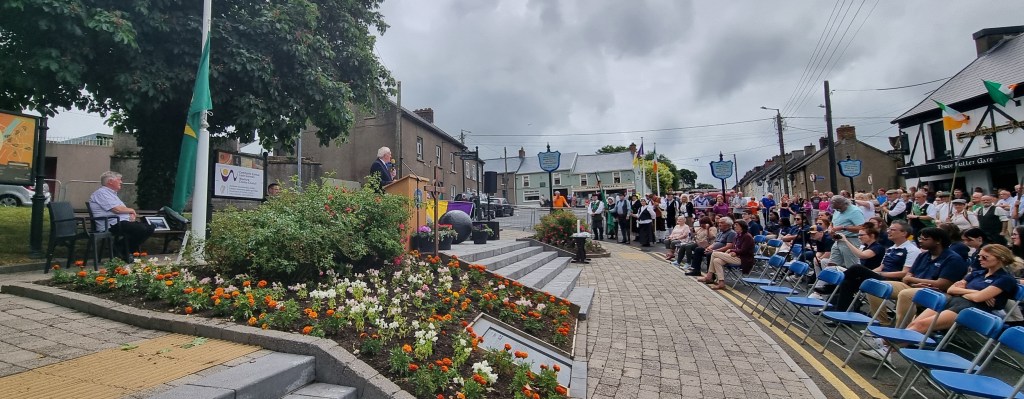
There was an excellent turnout for today’s 1798 Battle of Ross commemoration where former Taoiseach Bertie Ahern was a special invited guest and was given a warm welcome on behalf of the townspeople by Cllr Michael Sheehan, Cathaoirleach New Ross Municipal District Council.
A Colour Party from the New Ross FCA Pipe Band under Pipe Major Pascal Bolger followed by The Three Bullet Gate Pike Group under Captain Joe Cullen and Enniscorthy Historical Re-enactment Society led by Ray Murphy opened proceedings with a march from the Youth Centre to the Three Bullet Gate Memorial Park where the commemorations took place.
Former Taoiseach Bertie Ahern honoured an invitation to rededicate the Three Bullet Gate Memorial Park which he officially opened in 1998 marking the bicentenary of the Battle of Ross during the Rebellion of 1798.
Afterwards Mr Ahern held a lengthy audience with the young students from Georgia Southern University who attended the ceremonies.
The keynote speech was delivered by Professor Kevin Whelan who explained the meaning of the events of 1798 and made comparisons with the modern era in an international context.
There was large emphasis on music. The Three Bullet Gate is commemorated in Amhrán na bFiann as An Bearna Baoil (The Gap of Danger) and in many other patriotic poems and songs.

Performers included New Ross & District Pipe Band led by Pipe Major Brian MacMahon, traditional airs from Danescastle Ceilí Band, the premiére of the Ballad of the Bullet by Cathy Purcell was given a warm welcome, the Cumas Traditional Ceilí Band sounded great, Hayley Crosbie’s Ensemble contributed, and excellent master of ceremonies Seamus Kiely kept everything flowing smoothly and added a few appropriate songs.
The Battle of Ross was a military engagement that took place at The Three Bullet Gate on June 5th, 1798, fought between the Society of United Irishmen rebels and the government forces garrisoning the town.
The attack on the town was an attempt by the recently victorious rebels to break out of Co. Wexford, cross the River Barrow, and spread the rebellion into Kilkenny and Munster.
The rebels advanced from their camp on Carrigbyrne Hill to Corbet Hill, just outside New Ross town. The battle, is described in some sources as “the bloodiest of the 1798 Rebellion.”
It began at dawn when the Crown garrison was attacked by a force of almost 10,000 rebels, massed in three columns outside the town. The attack had been expected since the fall of Wexford town on May 30th and the garrison, consisting of 2,000 troops, had prepared defences both outside and inside the town.
Trenches were dug and manned by skirmishers on the approaches to the town while cannon were stationed facing all the rapidly falling approaches and narrow streets of the town to counter the expected mass charges by the rebels, who were mainly armed with pikes.
 WexfordLocal.com