By Dan Walsh
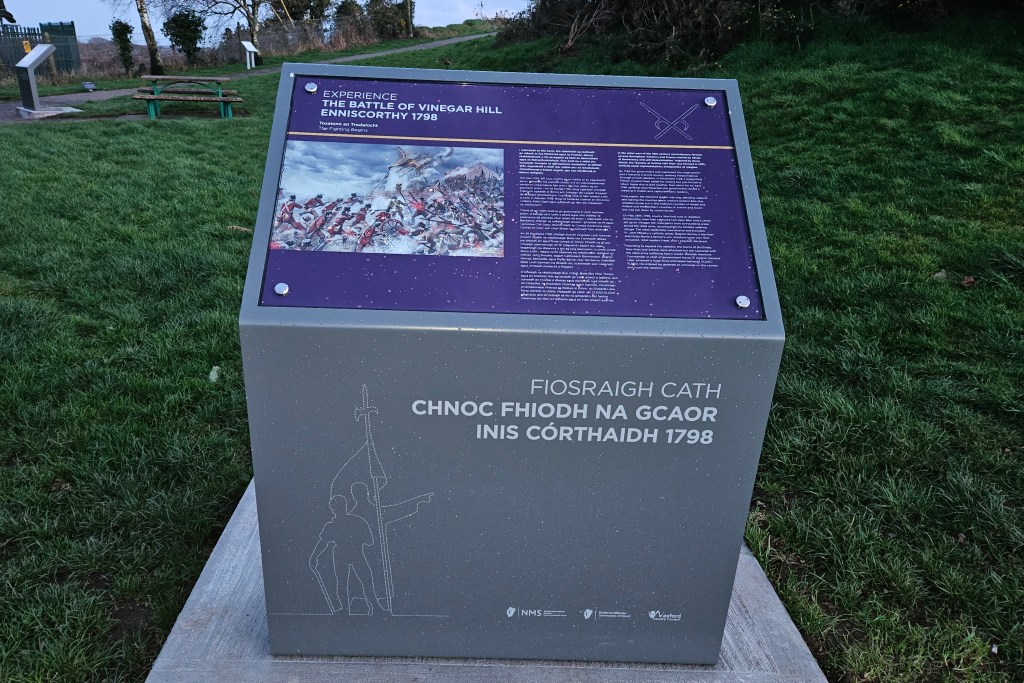
This week, two heritage signs, designed in the style of the 1916 information sign located opposite the Seamus Rafter Bridge, were officially unveiled on Vinegar Hill.
The signs have been awaiting delivery for some time now and the news was welcomed by members at Tuesday’s monthly meeting of Enniscorthy Municipal District Council held in the Chamber at the Presentation Centre.
The 1998 bicentenary monumental display continues to serve as a public information source and venue for annual wreath-laying ceremonies.
A brief extract from the signage informs visitors to Vinegar Hill that; “On the morning of 21 June, (1798) there were approximately 10,000 Crown Forces in position. The Crown Forces were well armed with cannons and muskets, in comparison to the Rebels who had meagre weapons such as pikes.
“The Rebels’ position ahead of the battle was further weakened by the absence of Edward Roche and re-enforcements from Wexford town, who had yet to arrive. Furthermore, in the weeks leading up to the Battle of Vinegar Hill, the Rebels had made no attempt to make the hill a formidable defensive position.”
“On June 21 at 3 am, the battle commenced. General Johnson commenced artillery bombardment on the Rebel positions on the outskirts of Enniscorthy town, while General Lake commenced artillery bombardment of the Rebel positions on Vinegar Hill. Following intense artillery bombardment Rebel leaders positioned on the outskirts of the town retreated towards the Duffry Gate.
“At 7 am, Lake’s forces commenced infantry assault on the Rebels on Vinegar Hill. By this time the Rebels in the town were engaged in intense house to house fighting with General Johnson’s troops. The Rebels based in the town pulled back over Enniscorthy Bridge and a stalemate ensued. During the stalemate the Rebels and Crown Forces inflicted heavy casualties upon each other.”
For more information contact the National 1798 Rebellion Centre on Parnell Road for exhibits, artefacts and stories. Opens 9.30am.
 WexfordLocal.com